The reading path where every stop ends in a joke.
Free, start to finish. Then the funny books they can actually read: $75 once, every child, no subscription.
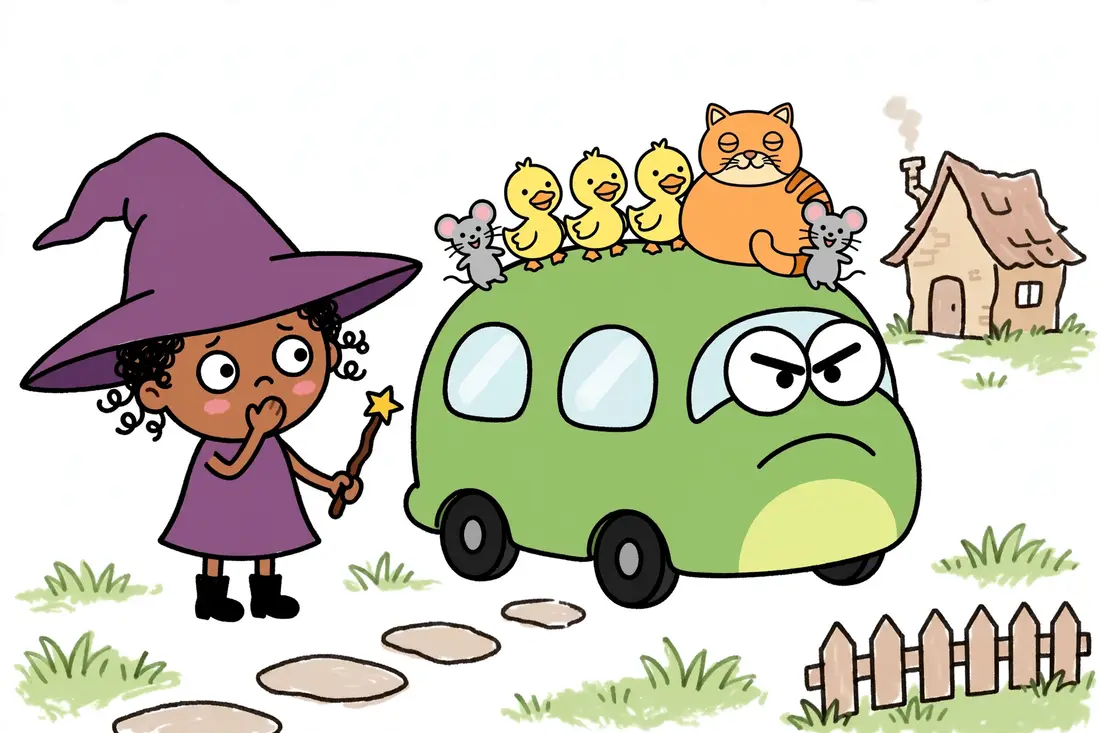 Gus Is a Bus! · page 5
Tap any word to hear it. Your child reads every line, and help is one tap away.
Kids don't hate reading. They hate boring phonics practice.
Drills and flashcards feel like homework, and homework gets skipped. A book that makes them laugh, in words they can sound out, feels like a win. And a child needs lots of them.
Sam sat. Sam sat on a mat. The mat is tan.
"Get off me! All of you!"
"I can fix it!"
Zap! Gus is Gus.
Same short words. One of them makes a five-year-old laugh out loud and turn the page.
The research is on the funny book's side. No study has found the level of decodability that makes a better reader. What it does find: reading and wanting to read feed each other. See the research
Learn every sound on the Path. Read it in the books.
10 lands, from m to tricky spellings
Every sound in the order schools teach it, one short, silly stop at a time. Each land has its own host.
See every sound on the Path →174 books in 6 series
Every book has a one-minute warm-up made from its own words, and two ways to read it: Read to me, or I'll read.
See every book →And the tricky little words? Pip brings them in 207 short cartoons.
You can draw a pig. You can't draw the, in, under or said. Instead of flashcards, your child taps two words in a tray — in and on, the and a — and watches the picture change on poor Ned. Just 24 little words make up 48% of every word in our beginner books.
Try a Little Word cartoon and see all 207 →Hear it. See it. Slide it. Spell it. Read it.
Your child hears the sound, watches Ned build a word from it, slides a finger under the letters, spells it, and then reads a tiny book where the word comes true. Ned hates that part. Your child loves it.
Then the stop hands them a book from the shelf made for that sound.
Go straight to it.
- Nothing is locked.Tap sh and play sh tonight.
- Already reading?Answer one question, or let them spell five words and move on.
- One card for you.The sound they're on, the sounds they've done, how far through the land. No grades, no "behind".
In most beginner books, the words are the hurdle. In ours, they're the magic.
The grown-up reads the setup. The kid reads the punchline. Six series, each with its own running joke, and your child is in on every one.
The best one makes the shelf.
The art and voices are AI. The jokes are ours.
AI lets a small team write about ten stories a week, keep only the best, and redraw a page as many times as it takes. That's how the price stays $75. People write every joke, check every word, and read and listen to every line before a book goes out.
How we make our books →Two ways to read the same book.
Pick one on the cover. Switch any time.
Read to me
Not reading yetThe characters read every line, the pages turn on their own, and the next book starts. Like a show, except it's a book.
My turn
Starting to readYour child reads every line. Help is always there: tap any word, line or picture and it reads itself.
A four-year-old listens. A six-year-old reads. Same book, one tap apart.
A study behind every screen. A joke in front of it.
Every screen starts with one question: what does the reading research say?
Made for real families.
Every child, one tap
Each child picks a character face. Siblings switch in a tap, and each keeps their own books and their own place on the Path.
A win every week
Wins only. Never a grade, never a comparison.
 5 books this week, 2 read on their own.
Private by design
Your child's name never leaves your device. No ads, no chatbot, no trackers. Buying and settings sit behind a grown-up question.
The Path is free. The books are $75 once.
- Every book on the shelf: 174 and counting
- A new book every week, for good
- Every child in your home, every device
- No subscription, no per-child fee, nothing renews
The Reading Path is free for everyone. Buy once and every book we add after is yours.
Most kids spend a couple of years learning to read. Here's what two years of the usual options cost, next to ours.
| What you get | Two years | |
|---|---|---|
| Phonics subscription box | An app, plus a workbook and a few storybooks each month | $575 |
| Learn-to-read app | Lessons, games and a set of decodable stories | $150 |
| Boxed sets of decodable readers | 12 sets of 12 small booklets. Paper, no audio | $192–216 |
| Pip Reader | The Reading Path free; every book, a new one every week, character voices | $75 |
Prices from each product's own page, October 2026.
Free for your whole class. Actually free.
No trial, no roster, no student names. The whole Reading Path for every child, the whole shelf on your classroom screen, and any book you want them to read tonight, sent home.
Parents ask.
Where does my child start?
On the Path. Answer one question, or start at the very first sound. A child who already reads can spell five words to skip ahead. Nothing is locked.
Can my child really do it alone?
It's built for that. The host says every sound, any word reads itself when tapped, and nothing is locked. It's even better with you beside them.
Is the Path really free?
Yes, all of it. The books are what you buy: $75 once, for every child in your home.
Does it match what school teaches?
Yes: the same order of sounds schools use, every one listed on the Path page.
How does it teach sight words (heart words) like "the", "said" and "was"?
Without flashcards. When a stop needs a tricky word, Pip flies it in whole in a 40-second Little Word cartoon where your child swaps two words and watches the picture change. All 207 sight-word cartoons are free.
Will my six-year-old find it babyish?
The jokes are written for kids who like being in on the joke. Ned blames your child out loud. Dot gets everything wrong. Six-year-olds love being right.
Is it a subscription?
No. $75 once, for every child in your home, for good. On iPhone and iPad, Family Sharing works too.
Does my child need an account?
No. A grown-up signs in with an email, only to buy or to sync devices. Your child's name stays on your device.
What devices does it work on?
iPhone and iPad from the App Store, and any Android phone, tablet or computer in the browser. Books keep working offline.
Start the first sound tonight.
The Path opens right now in your browser. No sign-up, no card, nothing to install.
When they ask for the next book: $75 once, the whole shelf, every child.