 Pip Reader
A guide for parents
How to teach your child to read at home
Pip Reader · updated November 2026
The short answer: teach the sounds letters make, a few at a time, in a set order. Show your child how to blend those sounds into a word: sssaaammm, Sam. Then hand them books that use only the sounds they know. A few minutes most days, and stop while it is still fun.
That is phonics, and it is what most US states now require schools to teach. Five steps, a few minutes to read, and something to try with your child at each one, right on this page.
Tonight: tap four sounds, blend one word, then start lesson 1. No account.
Or read the five steps first ↓
Start with a few sounds, not the whole alphabet
Teach the sound a letter makes, not its name. m says "mmm", not "em". Start with four: a, m, s, t. Together they already make words: am, at, sat, mat. Stretch the sounds you can hold: mmm, sss, aaa. t is a quick tap, with no "uh" after it.
Lesson 1 starts with a. Do it with your child now:
Start lesson 1 free No account, no card.Why: children taught letter sounds in a planned order read better than children taught sounds as they come up. Sources
Blend: run the sounds together
Say the sounds without a gap, each one sliding into the next: sssaaammm. Then say it faster until your child hears the word: Sam. Point under each letter as you go. Start with words whose sounds you can hold, like Sam and am.
Why: in a randomized study, kindergartners taught to run the sounds together read new words more accurately than children taught to pause between sounds, who more often lost the first sound. Sources
Read books that use only the sounds they know
These are called decodable books. When every word can be sounded out, your child sounds it out instead of guessing from the picture. This one is from lesson 4. Your child reads the dark line: words made of a, m, s, t, plus a and the, two little words lesson 1 teaches. Ned says the rest.
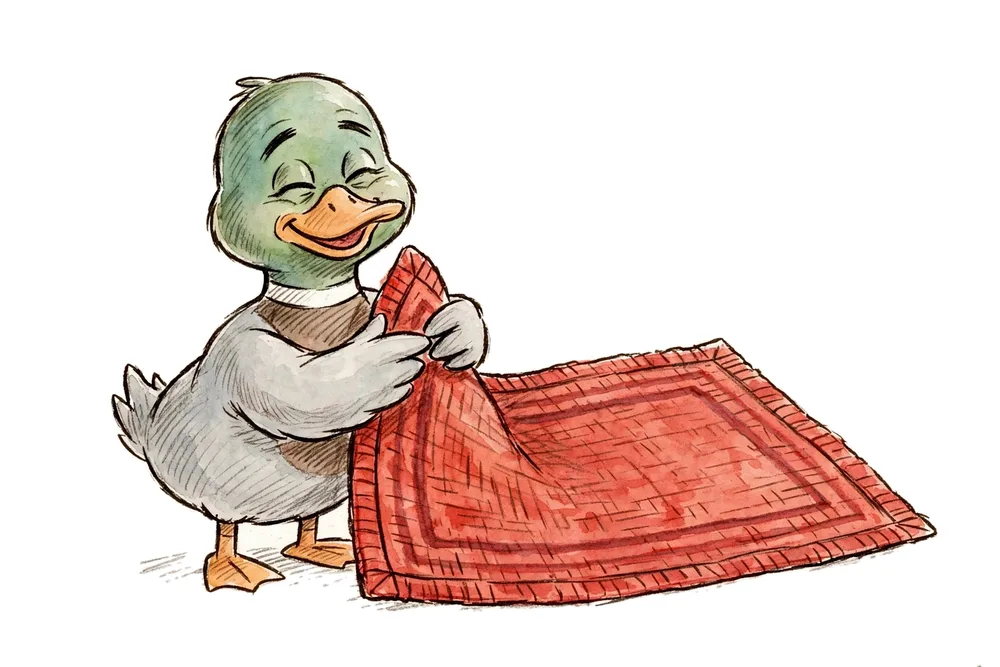 Lesson 4 · Sam Sat
This story is lesson 4. Lesson 1 is the sound a. Start there tonight:
Start lesson 1 freeWhy: a review of the research finds decodable text makes sounding out more likely. They are a tool, not the only thing a child should read: the goal is a child who wants to read. Sources
Add one new sound at a time, and keep using the old ones
When a, m, s, t are easy, add one more sound, then another. Each new sound unlocks new words, and yesterday's sounds keep showing up in today's words. Let your child spell words too: say "sat", and let them build it sound by sound. Spelling a word helps them read it.
Why: teaching spelling improves reading, not only spelling. Sources
Stop while it's still fun, and reread what they love
A few minutes most days beats one long session. End before your child is tired, so tomorrow starts with a yes. When they love a book, let them read it again and again: rereading builds fluency, and a child who wants to read reads more.
This book is free. The rest of the series, and every other book, opens with the Family Pass: $75 once, every child and every device. Nothing renews.
Why: reading the same text again builds fluency, children learn more new words from hearing the same story again, and children who like reading tend to read better. Sources
Try lesson 1 now: the sound a
- Your child hears the sound and finds the pictures that have it
- A short cartoon for a word that starts with it
- A tiny funny story at the end
No account, no card. Every lesson is free.
The hard part is a child who wants the next book
A new reader needs lots of books they can read, and they run out fast. We made every one funny, because the joy of reading starts with fun.
Pip Reader is the whole reading program: 128 lessons in the order schools teach, 1,500+ words taught, and 174 funny books your child can actually read. Any word they're stuck on reads itself with a tap. Every lesson is free. The Family Pass opens every book.
One hour with a reading tutor often costs more than $100.
Questions parents ask
When should I start teaching my child to read?
When your child is curious about letters and sounds. Most US schools start phonics in kindergarten, and some children are ready sooner or later. There is no test to pass first: start with one sound and see how it goes.
How do I teach a 4-year-old to read?
With the same five steps, kept short and playful: one sound, one blended word, then stop while it is still fun. Follow your child's interest: if they're curious about letters, they're ready to start.
How many minutes a day?
A few minutes, most days. Short and often is easier to keep up than long and rare. Stop while your child still wants more.
Does my child need to know the alphabet first?
No. Letter names help, but children read with letter sounds. Teach “mmm” for m, and the names can come along beside it.
Phonics or sight words?
Phonics first. Children remember a word by linking its sounds to its letters, not by memorizing its shape (Ehri, 2014). A few very common words, like “the”, come early, and they are still taught through their sounds.
What if my child guesses from the picture?
Cover the picture, point under the word, and sound it out together. Then show the picture as the reward.
Is Pip Reader free?
Every lesson on the Reading Path is free, and so is the first book of every series, with no account. The Family Pass opens every book: $75 once, for every child in your home. Nothing renews.
Sources
- Ehri, L. C., Nunes, S. R., Stahl, S. A., & Willows, D. M. (2001). Systematic phonics instruction helps students learn to read: Evidence from the National Reading Panel's meta-analysis (38 experiments). Review of Educational Research.
- Foorman, B., et al. (2016). Foundational skills to support reading for understanding in kindergarten through 3rd grade. Institute of Education Sciences.
- Gonzalez-Frey, S. M., & Ehri, L. C. (2021). Connected phonation is more effective than segmented phonation for teaching beginning readers to decode unfamiliar words. Scientific Studies of Reading.
- Cheatham, J. P., & Allor, J. H. (2012). The influence of decodability in early reading text on reading achievement. Reading and Writing.
- Graham, S., & Santangelo, T. (2014). Does spelling instruction make students better spellers, readers, and writers? Reading and Writing.
- Therrien, W. J. (2004). Fluency and comprehension gains as a result of repeated reading. Remedial and Special Education.
- Horst, J. S., Parsons, K. L., & Bryan, N. M. (2011). Get the story straight: Contextual repetition promotes word learning from storybooks. Frontiers in Psychology.
- Toste, J. R., et al. (2020). A meta-analytic review of the relations between motivation and reading achievement. Review of Educational Research.
- Ehri, L. C. (2014). Orthographic mapping in the acquisition of sight word reading, spelling memory, and vocabulary learning. Scientific Studies of Reading.
More on each, and what Pip Reader does with it: The science.